I have written before that, when it comes to muzzle devices, it has basically all been done before. There is a finite amount of gas to redirect in order to achieve the effect that the muzzle device manufacturer desires. We have reached the point where there are a number of good devices on the market with very small performance differences from device to device. Each device will have those who prefer it based on how it works with their style of shooting.
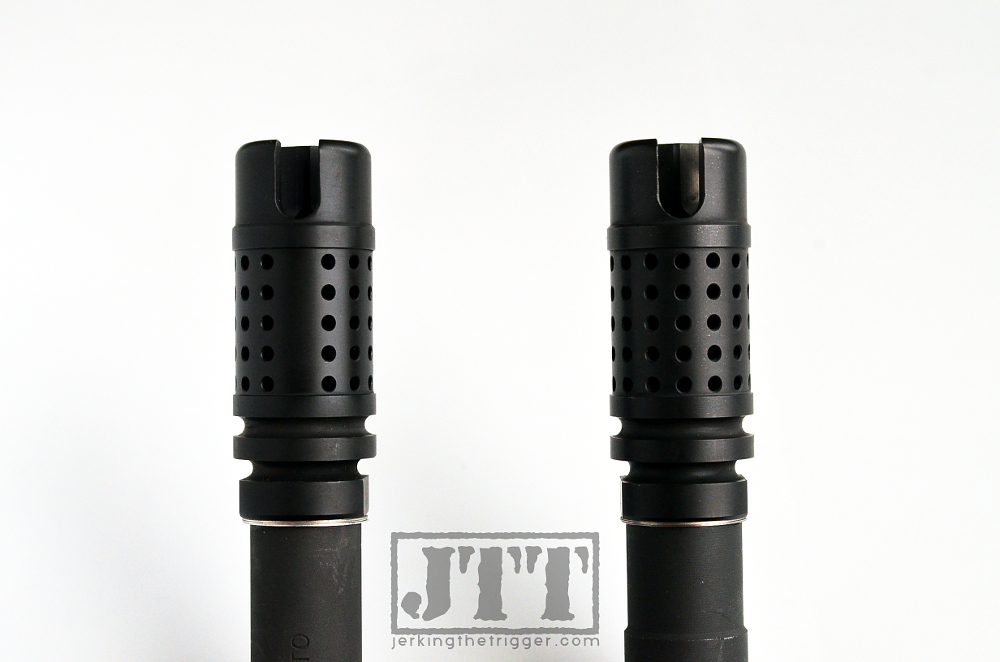
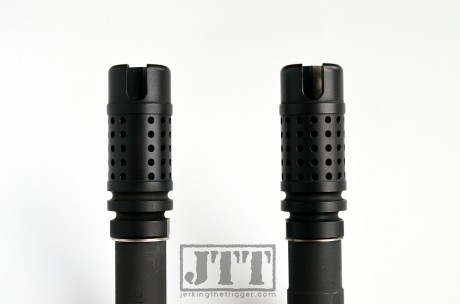
I recently had a chance to check out two versions of the same device that illustrates the above perfectly. I accidentally ended up with both a somewhat rare, very early version of the Griffin Armament M4SD-II Flash Comp and a current version. The differences are subtle but noticeable and they are indicative of the main difference between many devices on the market.
Overview
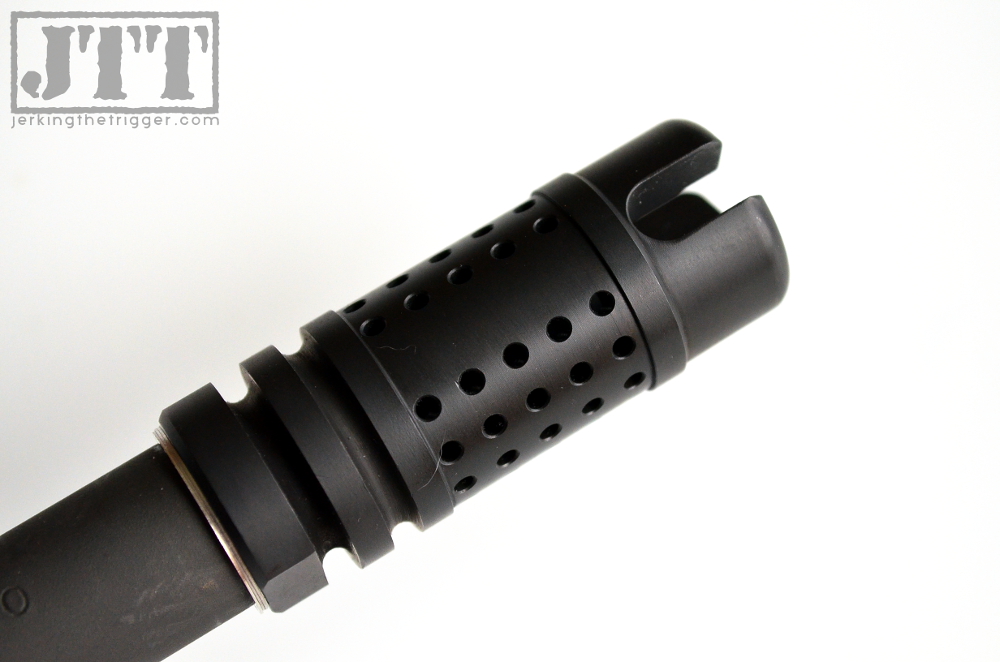
The Griffin Armament M4SD-II Flash Comp is a hybrid muzzle device. By that I mean is that it blends functionality from comps or brakes with flash suppression features.
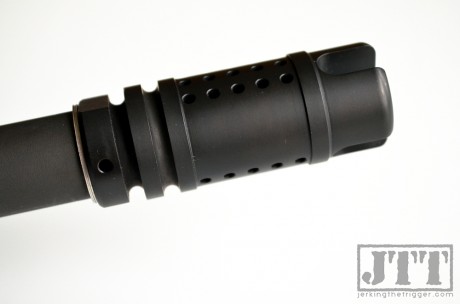
The Flash Comp is made from 17-4PH stainless steel with a black oxide finish. It is 2.25” long (long enough to bring a 14.5” barrel to 16”) and is pre-drilled for pinning. The Flash Comp is a touch on the heavy side at 3 ounces in weight.
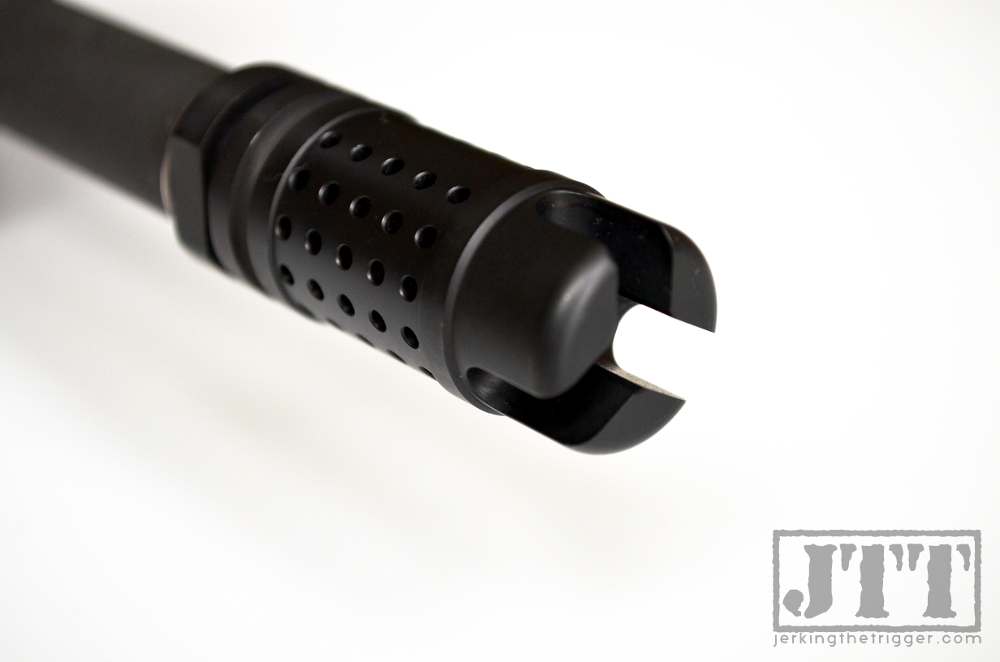
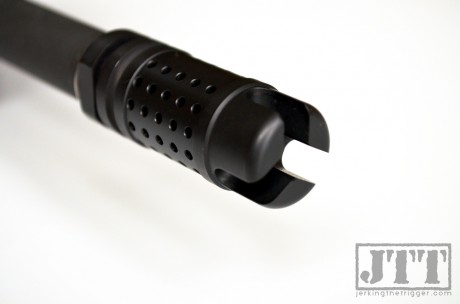
This device has one chamber with several small ports and three thick, short tines at the muzzle end to enhance flash suppression.
The early version has ports placed all around the circumference of the device except for the closed bottom. The current version is similar in that it also has a closed bottom but the top center row of ports has also been removed (more on this later).
Observations from Use
I’ll start with a bit of back story on how I ended up with 2 different versions of the Flash Comp. I have wanted to test this device for some time now so when I came across a used, but like new example on the secondary market for a great price, I jumped on it. After using it for a short time, I noticed that the Military Morons review mentioned that, as a result of their testing, the device would have the top row of ports removed to make it behave in a more neutral manner. My example still had the top row of ports. I contacted Griffin Armament and they confirmed that the Flash Comp that I had was an earlier version of which few were made. So, I purchased another device directly from Griffin Armament so that I would have the current and much more common version of the Flash Comp to test.
The story of how I ended up with both devices may not be all that interesting but the results of using both devices side by side and the window into the development process of a muzzle device that it provided was quite interesting. I was not part of the testing and evaluation that took place for this device but I had a rare chance to retrace the steps of that process and validate their findings.
In terms of muzzle rise mitigation, I saw exactly what Military Morons and other testers saw. The original version did exhibit a negative recoil impulse meaning the muzzle was forced down below the starting point. The original version behaves very similar to the BattleComp in that it pushes down but it can be muscled a bit to make it very controllable. The new version with the top row of ports removed was very neutral by comparison. It did not exhibit much, if any, push. It kept the muzzle very flat, even with a relaxed hold on the carbine. This is a pretty big plus to me. It feels very similar to the PWS FSC556 – a device known for keeping the muzzle very steady.
I think it speaks well of a company when they are willing and able to react to end user feedback the way Griffin Armament has. They removed the top row of ports and their device is better for it. It sounds simple but it is fairly rare for manufacturers to revise a product in this way. Kudos to them for listening to their customers.
Recoil mitigation was similar for both versions. They do a very good job of reducing what little felt recoil is present with an AR-15 chambered in 5.56.
The Flash Comp has three thick tines at the end to serve to reduce flash so I was hoping for great things but overall, the flash reduction is not quite as good as an A2 or PWS FSC556, but better than most open side brakes. I can already hear you asking if it is better or worse than the BattleComp and I would say it is too close to call with the naked eye.
FOLLOW UP: I spoke with Griffin Armament and their testing indicates that the Flash Comp suppresses flash better than what I experienced (which was still VERY good for a comp). The ammo that I used, mostly Prvi 75gr. probably lacks any sort of flash retardant in the powder which may account for the difference in performance. Griffin Armament tested with M855 and the Flash Comp performed very well with it.
All comps and brakes are loud relative to a dedicated flash suppressor. The M4SD II Flash Comp is less concussive than something like an open side port device but louder and more concussive, especially to those adjacent to the device, than something like an A2 flash suppressor. Comparing noise levels between the Flash Comp and similar devices like the PWS FSC556 and BattleComp is somewhat problematic because I can’t tell a difference between them when standing within 2 feet of the muzzle. However, when standing back more than 8 feet, the Flash Comp sounds and feels less concussive than a PWS FSC556 and about the same as a BattleComp.
There is a disparity in how these devices sound at various distances. I first noticed this after reading something written by Andrew at Vuurwapen Blog and it is something that I had neglected to test. The difference between the sound of the devices doesn’t become readily apparent until you back up several feet. Many of these devices are marketed (Griffin Armament doesn’t make such claims) as providing muzzle rise mitigation within the context of situations that may have team members in close proximity and/or the necessity of shooting in enclosed spaces, there really won’t be a noticeable difference between most modern hybrid devices. In tight spaces and with short distances between team members, they will all be ear splitting.
This isn’t a knock on the M4SD II Flash Comp. It is more of a reality check on what we (myself included) have expected from these devices in the past. All of the comps mentioned in the previous paragraphs feel less concussive than something with large unobstructed side parts and much more concussive than an A2 flash suppressor.
Wrap Up
The Griffin Armament M4SD II Flash Comp serves up a lot of value (retail is less than $85). It is made from steel that is well suited to the application, offers very neutral muzzle rise mitigation and sufficient recoil reduction. Its flash suppression performance was a little disappointing given the presence of the tines but it was on par with similar comps.
Given the attractive price and neutral muzzle rise attributes, I think the M4SD II Flash Comp is a real winner. I am thrilled with it. This is probably my favorite all-around muzzle device offering a good mix of balanced recoil control and flash suppression.